
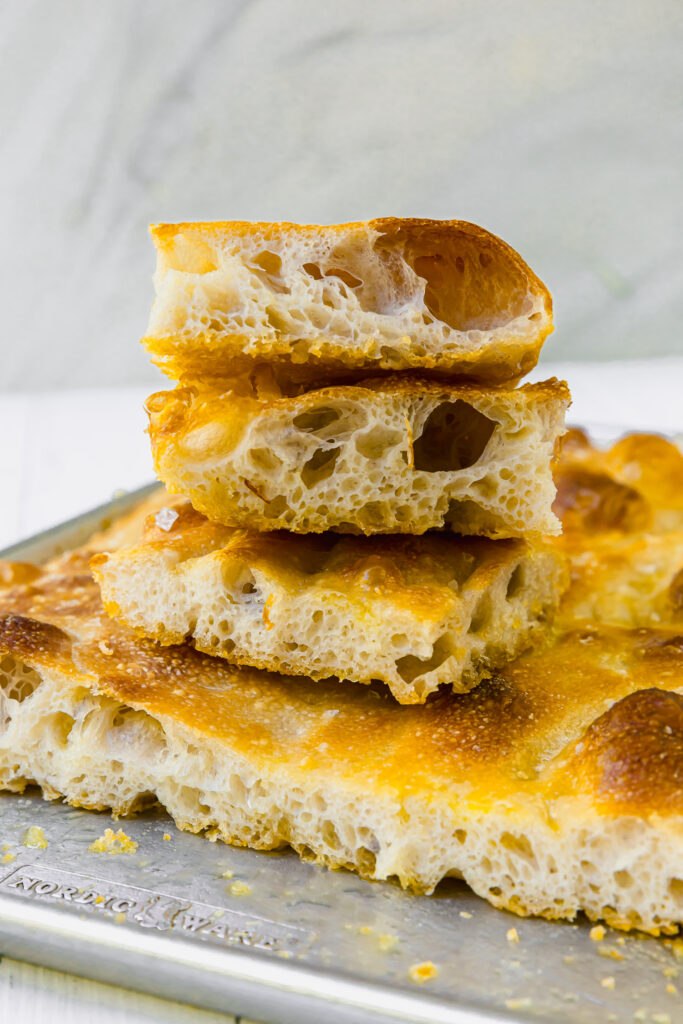
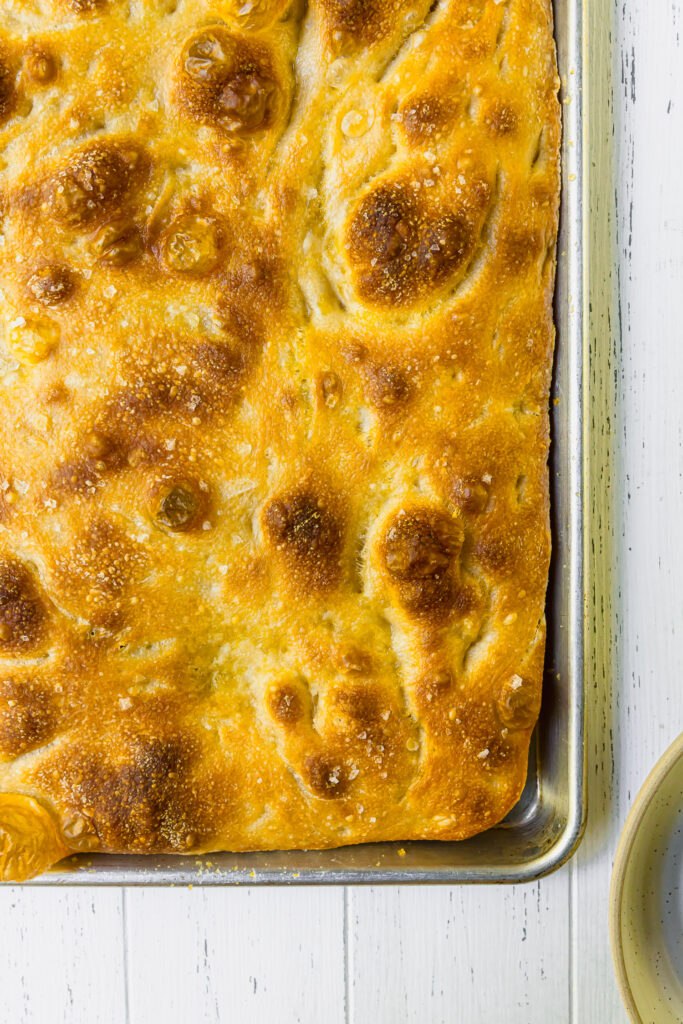
If you’ve ever found yourself standing over a sheet pan of warm, olive oil-drenched bread, tearing off piece after piece with absolutely no self-control—congratulations, you’ve met focaccia. This is not your average loaf. It’s the crispy, chewy, deeply golden, salty, slightly oily (in the best way) bread of your dreams. The edges? Perfectly crunchy. The center? Soft and airy. The top? A salty, dimpled wonderland begging to be torn apart and devoured. It’s the bread that needs no toppings but somehow makes every sandwich, soup, or haphazard snack session exponentially better.
Focaccia is a study in how a few simple ingredients can make something truly otherworldly. It’s a matter of six ingredients (excluding water), so be sure to use the best quality olive oil can you find, good flaky sea salt, and a high-quality bread flour you can get your hands on—locally milled is great if you can find it, but King Arthur bread flour is my go-to. Making great focaccia is about technique, patience, and a whole lot of olive oil. This recipe, inspired by Claire Saffitz, Samin Nosrat, and Giuseppe Dell’Anno, takes the best of both worlds: a beautifully elastic dough and a genius saltwater brine that gives it that signature crispy-yet-pillowy texture. The best part? It’s surprisingly low-effort. Sure, you have to let it rest overnight (and yes, that wait is painful), but most of the time, you’re just watching dough do its thing. And trust me—when you pull that golden slab from the oven, the wait will feel 100% worth it.
A Little History: Focaccia, aka the OG Flatbread
Before there was pizza (yes, pizza owes its existence to this beauty), there was focaccia. This rustic, olive oil-rich bread dates back to the Etruscans and Romans, who were out here making crisp, dimpled loaves before it was cool. Focaccia (or “panis focacius” as the Romans called it) was originally cooked on the hearth, giving it a slightly charred, crisp crust while staying pillowy inside.
Over the centuries, this beloved bread evolved into a staple across Italy. Liguria, in particular, takes its focaccia game seriously, producing versions that are deeply golden, salty, and kissed with olive oil. Other regions have their own spins—some with rosemary, others with olives and tomatoes, or even a sweet variation. But at its core, focaccia is all about simplicity: flour, water, yeast, salt, and an irresponsible amount of olive oil.
What Makes a Great Focaccia?
A great focaccia should hit a few key marks:
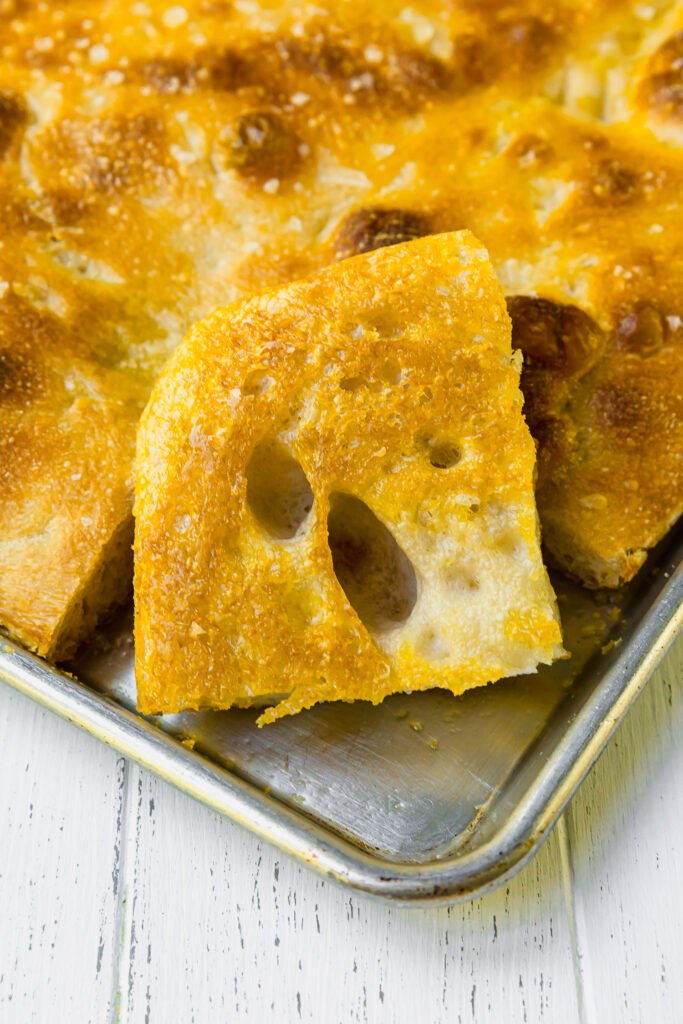
- Crispy, golden edges thanks to all that olive oil (seriously, it’s practically deep-fried at the bottom).
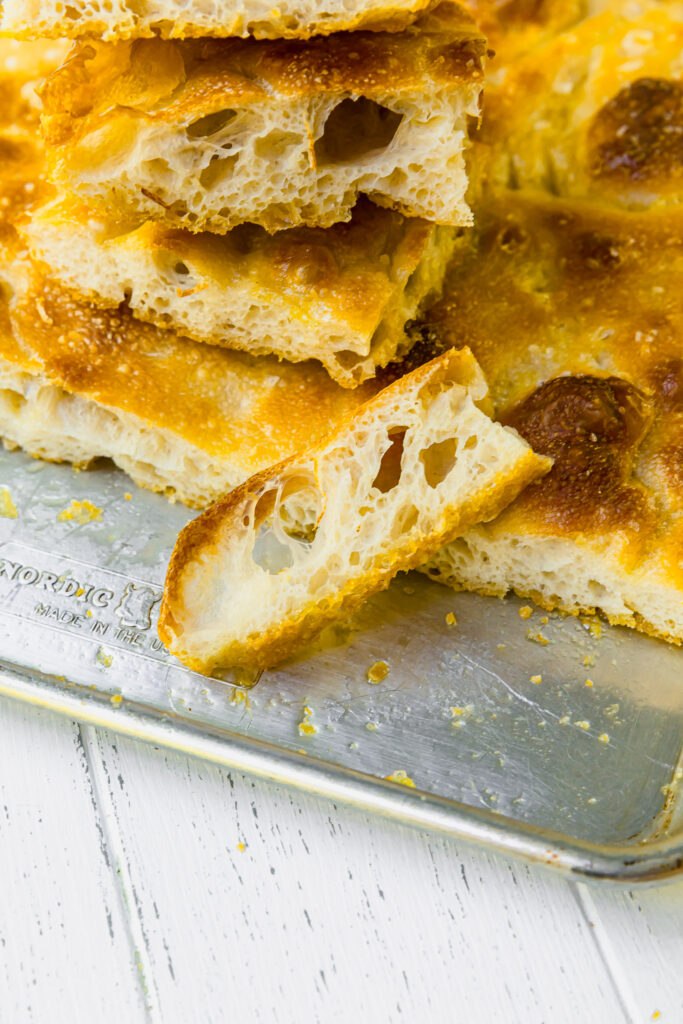
- A fluffy, chewy interior that’s light but not dry.
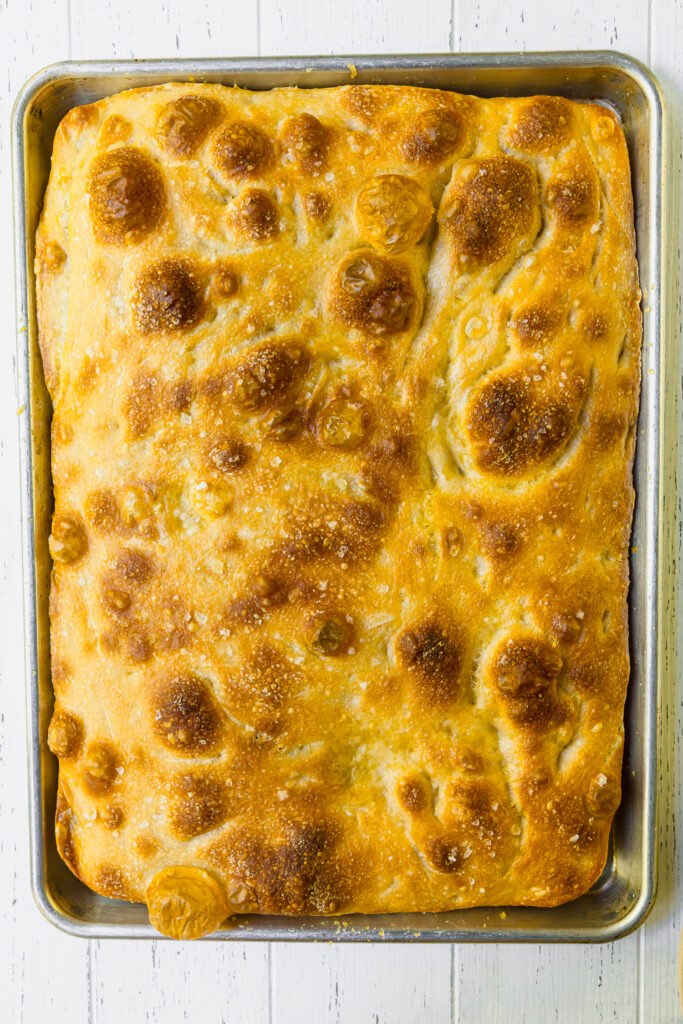
- A salty, dimpled top that shatters just slightly when you bite into it.
- Oil-soaked, but in a good way—like it just had a luxurious spa treatment in extra-virgin olive oil.
The Recipe: A Claire Saffitz x Samin Nosrat x Giuseppe Dell’Anno Hybrid
This recipe borrows inspiration from Claire Saffitz’s ingredient amounts and technique and Samin Nosrat’s and Giuseppe Dell’Anno’s brine/emulsion methods, creating the ultimate balance of flavor and texture. It’s the kind of bread you’ll find yourself picking at straight from the pan because waiting for it to cool is for people with patience (so, not me—I usually eat a third of it within 20 minutes of coming out of the oven. I simply cannot control myself).
Equipment Needed
- Liquid measuring cups
- Food scale
- Stand mixer
- Metal mixing bowls
- Rubber spatula
- Half-sheet pan with lid
- Cooling rack
- Metal fish spatula
The Process (Because Good Bread Takes Time)
- Weigh Your Ingredients: If you take away one thing from this recipe, let it be this: Weigh your ingredients. It’s worth saying and putting it in bold twice! Measuring by weight instead of volume ensures consistency and accuracy, especially for something as finicky as bread dough. Flour can be wildly inconsistent when measured by cups, and the difference can make or break your focaccia. Kitchen scales are relatively affordable and invaluable in so many recipes.
- Mixing the Dough: This is a high-hydration dough, meaning it’s wetter and stickier than your standard bread dough. That’s on purpose. Kneading it in a stand mixer makes it easier, but be warned: it will fight you before it gets smooth and stretchy.
- First Rise: The dough gets coated in olive oil (read: a slip-n-slide for yeast) and left to rise at room temp until it doubles in size.
- Stretch & Fold: Instead of aggressively punching down the dough, you’ll gently stretch and fold it, developing gluten structure while keeping that airy texture intact.
- Overnight Proofing: This step is not optional if you want maximum flavor. A slow proof in the fridge gives the dough time to develop a deeper, more complex taste.
- Dimpling & Brining: The signature move—pressing deep dimples into the dough with oiled fingers, then drenching it in a warm water + olive oil brine. This gives it that crisp, salty crust we all love.
- Baking: Start on a lower rack to build that crispy foundation, then finish it on a higher rack for that deep golden top. The result? A focaccia that’s simultaneously crunchy, fluffy, and impossibly good.
Tips for the Best Focaccia of Your Life
- Use a lidded baking sheet instead of plastic wrap. A lidded sheet pan is a game-changer for proofing dough. It keeps the dough from drying out and prevents any sticking disasters that can happen with plastic wrap. Plus, it’s just easier.
- Use a high-quality olive oil, flaky sea salt, and bread flour. If your bottle says “light-tasting” or “for sautéing,” put it back. You need the good stuff.
- I use King Arthur bread flour, Maldon sea salt or another flaky variety, and my everyday olive oil is Olio Santo.
- Don’t skimp on the salt. Focaccia should be salty in a way that makes you want to eat the whole pan in one sitting. One key thing to note: The measurement of kosher salt given in the recipe is strictly for Diamond Crystal kosher salt, my go-to. You absolutely cannot use salts interchangeably or your risk under- or over-seasoning your dish. Here is a handy guide on converting salt measurements depending on what variety you’re using.
- Be patient. The dough is sticky, the overnight proof feels unnecessary, and the smell will make you want to rip into it immediately. Trust the process.
- Eat it fresh. Focaccia is at its peak the day it’s made. If you must save some, reheat it in the oven to bring back the crispness. This also freezes extremely well when wrapped and stored properly.
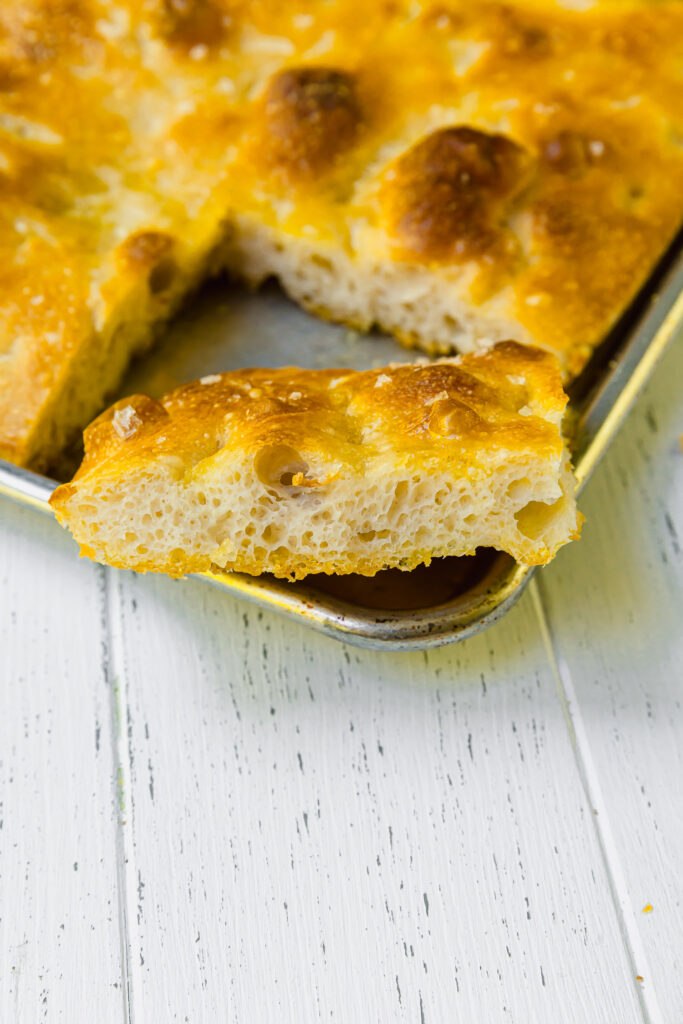
This is the kind of bread that makes you question why you ever bought the store-bought version. It’s simple, but also kind of magical. With every bite, you get crispy, salty, olive oil-soaked perfection—so much so that you’ll start wondering why you didn’t make two pans.
Happy cooking!
[tasty-recipe id=”48435″]
Leave a Reply